

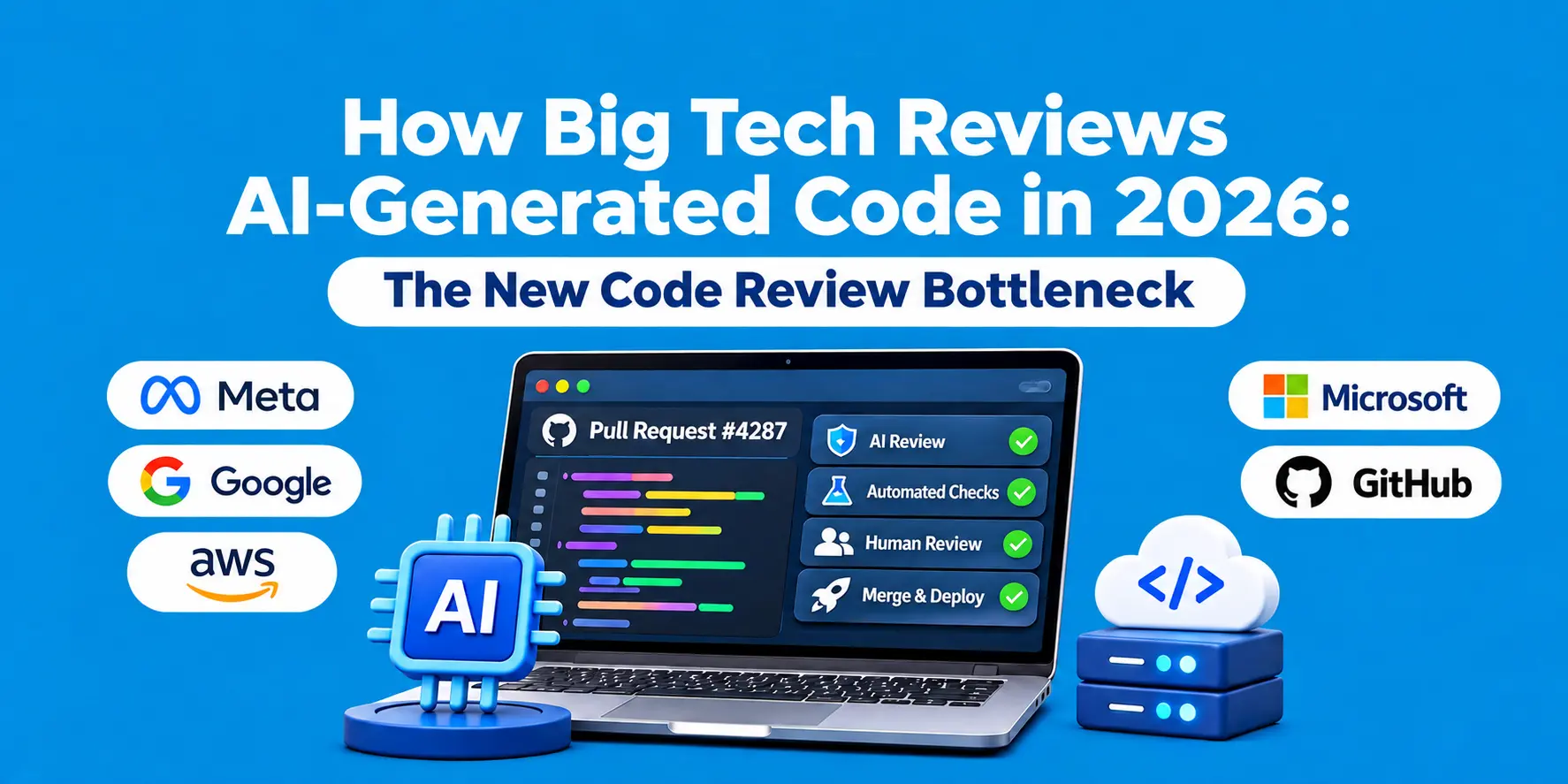
AI coding agents such as Claude Code, OpenAI Codex, and GitHub Copilot can implement features, refactor applications, generate tests, and open pull requests in minutes. But if an agent can generate 2,000 lines of code in 10 minutes, who reviews all of it? In this article, we'll explore how Meta, Google, Microsoft Research, GitHub, and AWS are tackling the new code review bottleneck through automated verification, specialized AI reviewers, risk-based approval, and human oversight.
Go To...
- Introduction
- Understanding the Traditional Code Review Process
- Why AI Coding Agents Create a Review Bottleneck
- What Recent Research Reveals
- Meta's RADAR: Automating Low-Risk Code Reviews
- Google's Sashiko: Reviewing Linux Kernel Patches
- AWS: Building a Gated AI Code Review Pipeline
- GitHub Copilot as an Automated Reviewer
- Comparing Industry Approaches
- Modern AI-Assisted Code Review Architecture
- Practical Example: Reviewing an AI-Generated API
- Why AI Reviewing AI Is Not Enough
- Measuring Automated Code Review Effectiveness
- Engineering Challenges and Limitations
- The Future of Code Review
- Conclusion
- References
Introduction
Software engineering is changing faster than traditional development workflows can adapt.
A few years ago, developers spent most of their time writing code, debugging applications, and implementing features. Code review was a natural part of the process because the speed of code generation was largely limited by human effort.
In 2026, that assumption is being challenged.
AI coding tools such as Claude Code, OpenAI Codex, GitHub Copilot, and other autonomous coding agents can implement features, refactor applications, generate tests, and create pull requests in minutes.
A developer can assign multiple tasks to different agents and receive hundreds or thousands of lines of generated code in a short period.
But this creates a new problem.
Who reviews all this code?
If an AI agent can generate 2,000 lines of code in 10 minutes, a human engineer may need significantly longer to understand the implementation, identify potential failures, and verify its behavior.
Now imagine an engineering organization where hundreds of developers are using multiple coding agents simultaneously.
Traditional line-by-line human review becomes difficult to scale.
Recent engineering publications from Meta, Google, AWS, and Microsoft Research show that organizations are already confronting this challenge.
The emerging approach is not simply replacing human reviewers with AI. It is building a layered process where automated tools handle mechanical checks, AI agents investigate potential defects, and human engineers make important approval decisions.
In this article, we'll explore how these systems work, what the research actually demonstrates, and how engineering teams can build more scalable code review workflows.
Understanding the Traditional Code Review Process
Code review is a fundamental software engineering practice used to improve correctness, maintainability, security, and overall code quality.
In a typical development workflow, an engineer implements a feature and creates a pull request. Another engineer examines the changes before approving them.
The traditional process looks like this:
          Developer
              |
              v
       Write / Modify Code
              |
              v
        Create Pull Request
              |
              v
      Automated CI / Tests
              |
              v
        Human Code Review
              |
       +------+------+
       |             |
       v             v
 Request Changes   Approve
       |             |
       v             v
  Developer Fixes   Merge
       |             |
       +---> Review  v
                 Production
A reviewer typically evaluates correctness, architecture, security, reliability, readability, testing, and potential regressions.
Google's public Engineering Practices documentation emphasizes improving overall code health rather than merely checking whether a change works.
An experienced reviewer looks beyond syntax and formatting.
Consider the following Python function:
def update_balance(account, amount):
    account.balance += amount
    save_account(account)
At first glance, the implementation looks reasonable.
But several questions remain:
- What happens when two requests update the same account simultaneously?
- Can an unauthorized user update the balance?
- What happens if the database transaction fails?
- Is the operation safe to retry?
- Should the amount be validated?
A human engineer may identify these concerns through experience and understanding of the system.
However, manually performing this level of review for every AI-generated change becomes increasingly expensive.
Why AI Coding Agents Create a Review Bottleneck
AI coding agents dramatically reduce the effort required to produce code.
Previously, a developer might spend several hours implementing a feature and then create a pull request for review.
Now the developer can describe a requirement and let an agent generate an implementation, tests, and documentation.
The challenge is that code generation and code verification do not scale at the same rate.
A Simple Example
Consider a hypothetical engineering team.
| Metric | Traditional Development | AI-Assisted Development |
|---|---|---|
| Developers | 10 | 10 |
| Pull requests per developer per day | 2 | 6 |
| Total pull requests daily | 20 | 60 |
| Average review effort per PR | 30 minutes | 30 minutes |
| Total daily review effort | 10 hours | 30 hours |
These are illustrative numbers, not measurements from a specific company.
The example demonstrates that a threefold increase in pull-request production can create a threefold increase in review demand if review effort remains unchanged.
Adding more coding agents may improve implementation throughput while increasing the workload placed on reviewers.
The Review Queue Problem
We can express this using a simple relationship:
ΔQ = λ − μWhere:
λ= incoming pull requests per unit of timeμ= completed reviews per unit of timeΔQ= net change in the review queue
If code arrives faster than reviewers can process it, the review backlog grows.
This is the central bottleneck created by large-scale AI-assisted development.
The important question is no longer only how much code an engineering team can generate.
It is how much code the team can confidently validate and deliver.
What Recent Research Reveals
Several studies published in 2026 provide quantitative evidence of the problem.
Meta: Code Generation Is Outpacing Review
In May 2026, Meta researchers published a study titled Automating Low-Risk Code Review at Meta: RADAR, Risk Calibration, and Review Efficiency.
The researchers reported the following year-over-year changes:
| Metric | Reported Change |
|---|---|
| Significant lines of code per human-landed diff | +105.9% |
| Diffs per developer per month | +51% |
| Share of growth attributed to agentic AI assistance | More than 80% |
The study also reported a decline in the percentage of diffs reviewed within 24 hours.
This suggests that code production was increasing faster than available human review capacity.
Some large groups accumulated thousands of pending reviews.
Meta's response was to automate the review and landing of selected low-risk changes rather than attempt to automate every review indiscriminately.
Microsoft Research: Review Workload Doubled
A July 2026 study, AI Writes Faster Than Humans Can Review, analyzed software development activity involving:
- 802 developers
- 196,212 pull requests
- Data collected between January 2024 and April 2026
The study found that per-developer pull-request throughput reached 2.09 times its earlier baseline by April 2026.
However, reviewer workload also approximately doubled, and automated reviews overtook human reviews.
Merge and revert rates remained relatively stable during the observed period.
The study examined a particular enterprise initiative; these results should not be generalized to every Microsoft engineering team.
Nevertheless, the findings illustrate a significant shift: AI-assisted development can increase code production while transferring more work to review systems.
How Good Are AI Review Agents?
An October 2026 research paper, (When) Should a Software Factory Be Lights-off? Benchmarking Code Review Agents on Bug Detection, introduced CRBugBench.
The benchmark included 1,000 review tasks from 98 open-source GitHub repositories and 800 additional tasks from proprietary industry repositories.
The researchers evaluated whether AI review agents could identify previously confirmed software defects.
One of the best evaluated configurations detected 71.9% of benchmark bugs within its top five review comments, compared with 47.7% for an earlier model configuration.
However, performance deteriorated for more complex changes, particularly in proprietary repositories requiring additional project-specific knowledge.
This is an important result.
AI reviewers can detect a substantial proportion of software defects, but they are still far from guaranteeing correctness.
Meta's RADAR: Automating Low-Risk Code Reviews
Meta introduced RADAR (Risk Aware Diff Auto Review) to address the increasing volume of pull requests.
Instead of requiring identical review procedures for every change, RADAR evaluates whether a proposed diff is eligible for automated review and landing.
Its architecture combines several verification stages.
RADAR Architecture
                Incoming Diff
                     |
                     v
          Authorship Classification
                     |
                     v
              Eligibility Gates
                     |
                     v
              Static Heuristics
                     |
                     v
          Machine-Learned Risk Score
                     |
                     v
              LLM Code Review
                     |
                     v
          Deterministic Validation
                     |
                     v
             Final Risk Decision
                     |
            +--------+--------+
            |                 |
            v                 v
     Eligible Change      Other Changes
            |                 |
            v                 v
       Auto-Landing       Human Review
RADAR uses a multi-stage process instead of trusting a single AI model's assessment.
Changes must satisfy several conditions before they qualify for automated approval and landing.
The system considers characteristics such as change origin, eligibility requirements, risk scores, and review findings.
Reported Results
Meta's study reported:
| Metric | Value |
|---|---|
| Diffs reviewed by RADAR | 535,290 |
| Diffs landed through RADAR | 331,720 |
| Daily reviewed throughput reached | 25,000 diffs |
| Observed revert rate | One-third of non-RADAR diffs |
| Observed production incident rate | One-fiftieth of non-RADAR diffs |
The last two values are observational comparisons, not proof that RADAR alone caused the improvement. The automated system intentionally selects changes that meet risk criteria, making direct comparisons difficult.
What Makes RADAR Interesting?
The most important idea is selective automation.
A documentation change and a security-sensitive authentication change should not necessarily require identical approval processes.
RADAR demonstrates that review automation can be calibrated to organizational risk tolerance.
Rather than attempting to eliminate humans from every decision, it preserves human attention for changes that are harder to verify or potentially more consequential.
Source: Meta RADAR Research, May 2026
Google's Sashiko: Reviewing Linux Kernel Patches
On November 18, 2026, Google published an engineering article about Sashiko, an open-source agentic code review system designed for Linux kernel development.
The Linux kernel is an especially challenging codebase because small changes may introduce memory leaks, deadlocks, race conditions, and security vulnerabilities.
Traditional automated tools such as compilers, static analyzers, and fuzzers can detect many defects.
However, some problems require a detailed investigation of the relationships between different functions and subsystems.
Google developed Sashiko to assist kernel maintainers with this work.
How Sashiko Reviews Code
Sashiko uses multiple specialized review sessions.
Its overall workflow can be summarized as follows:
                 Linux Kernel Patch
                         |
                         v
                 Gather Relevant Code
                         |
                         v
                 Review Planning
                         |
                         v
           Parallel Specialist Reviewers
                         |
           +-------------+-------------+
           |             |             |
           v             v             v
       Control Flow   Locking       Security
           |             |             |
           +-------------+-------------+
                         |
                         v
                   Finding Triage
                         |
                         v
                Per-Bug Verification
                         |
                         v
                    Review Report
                         |
                         v
                  Human Maintainers
The published system can run up to seven specialized review sessions covering different classes of potential problems.
Each session investigates code using repository tools and records both suspected defects and concerns it has ruled out.
A separate verification stage examines uncertain findings.
This helps prevent an AI reviewer from incorrectly dismissing a bug based on an unsupported assumption.
Sashiko's Reported Results
Google reported the following figures since March 2026:
| Metric | Reported Result |
|---|---|
| Completed patch reviews | 241,000 |
| Reviews per day | Approximately 1,200+ |
| Mainline commits crediting Sashiko | 2,000+ |
| Linux kernel CVEs crediting Sashiko in 2026 | 528 |
| Detection on a historical kernel-bug benchmark | 75.8% |
The 75.8% figure refers to a benchmark of nearly 1,000 real Linux kernel bugs that had previously escaped human review. It is not a guarantee of detection on arbitrary future patches.
Google also reported that the 60-day follow-up-fix rate fell from a historical 3.4% baseline to 2.2% for Linux 7.2.
The authors explicitly cautioned that other factors may have contributed to this improvement.
Why This Approach Matters
Sashiko demonstrates that code-review agents can perform more than superficial syntax checks.
They can investigate function behavior, locking, resource lifetimes, and interactions across complex systems.
The key distinction is between generating a possible defect report and investigating whether the defect is real.
Google's approach uses additional verification steps before presenting important findings to maintainers.
The maintainers remain responsible for deciding how to handle the reported issues.
Sources: Google Cloud Engineering Blog, November 18, 2026 | Sashiko GitHub Repository
AWS: Building a Gated AI Code Review Pipeline
On November 17, 2026, AWS published Building a Gated Review Pipeline for AI Coding Agents on AWS.
Unlike Meta's deployed RADAR system, this publication presents an engineering architecture and implementation pattern. It should not be interpreted as evidence that every Amazon engineering team uses this exact workflow.
The proposed design combines deterministic checks, specialized AI reviewers, risk-based policies, and human approval.
Six Review Controls
AWS describes six connected controls:
- Centralized engineering standards: Review tools apply consistent, versioned engineering and security policies.
- Deterministic gates: Formatting, linting, type checks, security scanning, and similar checks run before AI review.
- AI review panel: Specialized agents independently investigate correctness, security, and operational issues.
- Policy-based gating: Verified findings are evaluated against predefined risk rules.
- Human review: Engineers review pre-triaged changes and approve consequential decisions.
- Post-merge verification: Testing, operational monitoring, and incident analysis continue after deployment.
Risk-Based Review Levels
The proposed architecture distinguishes between three risk tiers.
| Tier | Example Changes | Review Requirement |
|---|---|---|
| T1 — Low | Documentation, internal tooling | Light human spot-check |
| T2 — Medium | Standard application features | Full review and tech-lead sign-off |
| T3 — High | Payments, authentication, data, CI configuration | Two human reviewers; architecture review when appropriate |
This prevents highly sensitive modifications from receiving the same review treatment as trivial changes.
Why Deterministic Checks Come First
There is little value in asking an expensive AI model to find problems already detectable by standard engineering tools.
For example:
# Check code style
ruff check .

# Run automated tests
pytest -q

# Run security analysis
bandit -r app/
These commands assume the corresponding Python tools are installed and configured.
Such checks are repeatable and generally easier to evaluate than probabilistic model-generated comments.
An AI reviewer can then concentrate on behavior, failure scenarios, and deeper implementation issues.
Why AWS Uses Specialized Reviewers
A single general-purpose reviewer may overlook an important category of defects.
For example, an agent might focus heavily on security while missing concurrency problems.
A specialized review panel distributes investigation across different concerns.
The architecture also recommends verifying AI-generated findings before presenting them to human reviewers.
This reduces the chance that incorrect or unsupported comments waste engineering time.
GitHub Copilot as an Automated Reviewer
For engineering teams using GitHub, AI-powered review can already be integrated directly into pull-request workflows.
GitHub Copilot code review can inspect proposed changes, identify potential issues, and suggest improvements.
Depending on repository settings and available features, developers can request a Copilot review directly or configure automated review behavior.
Example GitHub Workflow
        Developer / Coding Agent
                  |
                  v
             Open Pull Request
                  |
                  v
          GitHub Actions CI
                  |
                  v
           Copilot Code Review
                  |
                  v
            Suggested Changes
                  |
                  v
           Developer Evaluation
                  |
                  v
          Human Approval / Merge
The AI reviewer produces feedback that developers can examine and act upon.
However, an automated review should not automatically be considered a substitute for the required human approval or branch protection rules.
GitHub's documentation also describes configurable review effort levels and organization-level review settings.
These capabilities are useful because they integrate into existing developer workflows rather than requiring engineers to use an entirely separate system.
Source: GitHub Documentation — Using GitHub Copilot Code Review
Comparing Industry Approaches
The different systems reveal how organizations are addressing similar problems through different approaches.
| Organization / System | Primary Approach | Human Role |
|---|---|---|
| Meta RADAR | Automated landing of eligible low-risk diffs | Handles changes outside automation criteria |
| Google Sashiko | Specialized agentic investigation and bug verification | Maintainers evaluate findings and patches |
| AWS reference architecture | Deterministic gates, AI panels, policy enforcement | Risk-tiered approval |
| GitHub Copilot Review | AI-generated pull-request feedback | Developers evaluate suggestions and approve changes |
| Microsoft Research / CRBugBench | Empirical evaluation of review-agent effectiveness | Studies complementary human–AI review |
These examples do not establish a universal Big Tech review standard.
They show that different approaches are emerging based on codebase complexity, organizational requirements, and the consequences of software failures.
What they share is a move toward automation that supports, filters, or prioritizes human review.
Modern AI-Assisted Code Review Architecture
Combining the practical lessons from these systems, a modern code review workflow can be designed as a layered verification pipeline.
The architecture below is a suggested engineering workflow, not a claim that every company uses the same design.
                +----------------------+
                | Developer / AI Agent |
                +----------+-----------+
                           |
                           v
                +----------------------+
                |     Pull Request     |
                +----------+-----------+
                           |
                           v
                +----------------------+
                |   Automated CI/CD    |
                |----------------------|
                | Lint / Type Checking |
                | Unit / Integration   |
                | Static Security Scan |
                | Build Verification   |
                +----------+-----------+
                           |
                           v
                +----------------------+
                |    Risk Assessment   |
                +----------+-----------+
                           |
                           v
                +----------------------+
                |    AI Review Panel   |
                |----------------------|
                | Correctness Reviewer |
                | Security Reviewer    |
                | Reliability Reviewer |
                +----------+-----------+
                           |
                           v
                +----------------------+
                | Findings Verification|
                +----------+-----------+
                           |
                           v
                +----------------------+
                |  Policy / Merge Gate |
                +----------+-----------+
                           |
                           v
                +----------------------+
                | Human Review as      |
                | Required by Policy   |
                +----------+-----------+
                           |
                           v
                +----------------------+
                |    Merge / Deploy    |
                +----------+-----------+
                           |
                           v
                +----------------------+
                | Production Monitoring|
                +----------------------+
The main benefit of this architecture is that every stage has a distinct responsibility.
Deterministic tools identify mechanical problems.
Specialized AI reviewers investigate possible behavioral defects.
Verification checks whether important findings are supported by evidence.
Policies determine the level of approval required.
Finally, deployment monitoring provides additional evidence about the system's actual behavior.
The objective is not to generate as many review comments as possible.
It is to identify meaningful problems while reducing unnecessary review work.
Practical Example: Reviewing an AI-Generated API
Consider a simple API endpoint generated by an AI coding assistant.
The requirement is:
Implement a function that returns a customer's order information.
The generated code looks like this:
orders = {
    101: {"user_id": 1, "amount": 150},
    102: {"user_id": 2, "amount": 300}
}

def get_order(order_id, user_id):
    order = orders.get(order_id)

    if not order:
        return None

    return order
The code is syntactically correct.
It may also pass basic unit tests.
But it contains an important security vulnerability.
The function accepts user_id without verifying whether the order belongs to that user.
A customer with user_id=1 can request order 102, which belongs to user_id=2.
Step 1: Automated Testing
A normal functional test might look like this:
def test_get_order():
    result = get_order(101, 1)

    assert result["amount"] == 150
This test passes.
However, it does not check authorization.
Step 2: AI Security Review
A security-focused AI reviewer should identify the missing ownership validation.
A useful review finding might be:
Severity: High
Category: Broken Object-Level Authorization
Finding: The endpoint does not verify that the requested order belongs to the authenticated user.
Impact: A user may access another customer's order.
The reviewer should also identify how the vulnerability can be reproduced.
Step 3: Corrected Implementation
def get_order(order_id, user_id):
    order = orders.get(order_id)

    if not order:
        return None

    if order["user_id"] != user_id:
        raise PermissionError("Access denied")

    return order
For this example, user_id represents an identity already established by trusted authentication middleware. A production endpoint should not trust a user ID supplied directly by the client.
Step 4: Regression Test
import pytest

def test_unauthorized_order_access():
    with pytest.raises(PermissionError):
        get_order(102, 1)
This test demonstrates that a customer cannot retrieve another customer's order using the illustrated function.
Of course, additional tests would be necessary for a real service, including authentication failures, missing orders, database access, and error responses.
What This Example Demonstrates
Different review layers provide different types of assurance.
| Review Mechanism | Expected Result |
|---|---|
| Python syntax check | Pass |
| Basic functional test | Pass |
| Linting | May pass |
| Authorization-specific test | Fail on original implementation |
| AI security review | Should identify missing ownership check |
| Human review | Confirm intended authorization policy |
The important distinction is that code can pass automated checks and still violate a fundamental security requirement.
This is why relying on only one verification mechanism is dangerous.
Why AI Reviewing AI Is Not Enough
A natural question is whether AI-generated code can simply be reviewed by another AI agent.
In many cases, the answer is yes.
However, automated review should not be confused with independent proof of correctness.
AI Reviewers Can Miss Defects
CRBugBench demonstrates that even advanced review agents miss a meaningful proportion of known bugs.
The problem becomes harder for complex changes involving multiple components.
Multiple Agents Can Share the Same Mistake
Using two agents does not automatically provide independent verification.
If both agents make the same incorrect assumption, they may agree that a defective implementation is correct.
This is one reason AWS recommends using separate reviewer roles and considering different model families.
Passing Tests Does Not Prove Correctness
An AI agent may generate both an implementation and tests that validate the same incorrect interpretation of a requirement.
All tests can pass while the application still behaves incorrectly.
Tests establish that particular assertions hold under particular conditions.
They do not prove that every requirement has been satisfied.
False Positives Create Review Noise
AI reviewers sometimes report issues that do not actually exist.
A developer who receives many incorrect findings may spend additional time investigating harmless code.
Excessive noise can eventually reduce trust in the review process.
Human Judgment Remains Important
Some decisions require balancing engineering risk, business requirements, maintainability, and operational consequences.
An automated system may provide useful evidence, but a responsible engineer or team still needs to decide whether a consequential change should be deployed.
The real objective is human–AI collaboration with verifiable evidence, not blindly accepting model-generated approval.
Measuring Automated Code Review Effectiveness
Improving review speed is useful only if software quality remains acceptable.
Engineering teams should evaluate automated review using both efficiency and correctness metrics.
Review Latency
Measures the time a pull request spends waiting for and undergoing review.
A decrease may indicate that the workflow is becoming more efficient.
However, latency alone does not demonstrate improved code quality.
Defect Detection Recall
Measures how many known defects are successfully identified.
Recall = TP / (TP + FN)Where:
TP= correctly identified defectsFN= known defects missed by the reviewer
Higher recall generally means fewer defects are overlooked in the evaluated set.
Finding Precision
Measures the proportion of reported defects that are actually valid.
Precision = TP / (TP + FP)Where FP represents false-positive findings.
High precision is important for avoiding unnecessary developer work.
Escaped Defect Rate
Measures problems discovered after code has been merged or deployed.
This helps determine whether faster reviews are allowing more bugs through.
Change Failure Rate
Measures the proportion of deployments that result in failures requiring intervention.
This is related to established DORA software delivery metrics.
Review Cost
AI review is not free.
Running several advanced models on every pull request introduces compute and inference costs.
A useful efficiency metric is:
Cost per Valid Finding = Total Review Cost / Accepted Valid FindingsTeams can use this measure alongside defect recall, precision, and incident outcomes to determine whether additional AI review effort provides meaningful value.
A system that uses five expensive review agents but detects no additional defects may be less valuable than a simpler approach.
Engineering Challenges and Limitations
Despite the progress made in 2026, automated code review still faces several challenges.
Large Pull Requests
AI agents can generate substantial changes across multiple files.
Large pull requests are difficult for both humans and automated reviewers to evaluate.
Breaking changes into smaller, focused units can improve reviewability and make failures easier to isolate.
Cross-Service Failures
A code change may work inside one service but break assumptions in another.
For example, changing a message payload might cause downstream consumers to fail even though the producer's tests pass.
Concurrency and Distributed Systems
Race conditions, retries, partial failures, and duplicate processing are difficult to evaluate using simple functional tests.
These problems often require specialized testing, fault injection, or careful analysis of execution order.
Security-Sensitive Changes
Authentication, authorization, secrets handling, payment processing, and infrastructure permissions deserve additional scrutiny.
The potential consequences of a failure are more important than the number of lines changed.
False Confidence
A pull request marked as safe by an AI reviewer may still contain defects.
Engineering teams should avoid treating a model-generated approval as a mathematical guarantee.
Operational Costs
Large-scale review automation requires model inference, compute infrastructure, CI execution, storage, and monitoring.
Review depth should be proportionate to risk and demonstrated effectiveness.
The Future of Code Review
The evidence available in November 2026 suggests that software review is evolving in several directions.
More Automated Review Before Human Approval
Static analysis, automated tests, and AI review systems can identify many issues before a human engineer examines a change.
This allows reviewers to focus on unresolved concerns instead of repeatedly identifying simple problems.
Risk-Based Approval
Organizations can apply different levels of scrutiny depending on what a change affects.
Low-risk modifications may qualify for limited automation, while critical systems continue to require deeper human involvement.
Specialized Review Agents
Instead of asking one model to examine everything, teams can use specialized reviewers for security, correctness, reliability, and other concerns.
Google's Sashiko provides a concrete example of this approach.
Evidence-Driven Findings
AI-generated comments become more useful when they include reproducible failure scenarios, clear code references, and supporting evidence.
This reduces the amount of time developers spend investigating vague or incorrect warnings.
Verification Beyond the Pull Request
Software quality cannot be established entirely before deployment.
Monitoring, canary releases, rollback strategies, and incident analysis remain essential.
Automated review should therefore be considered one component of a broader software delivery system.
How Engineering Responsibilities May Shift
| Traditional Focus | Emerging Focus |
|---|---|
| Manually implementing features | Directing and validating implementations |
| Reading every changed line | Reviewing risks and significant behavior |
| Detecting simple mistakes manually | Using automated checks |
| Relying primarily on one reviewer | Combining specialized checks and reviewers |
| Treating merge as the final checkpoint | Monitoring outcomes after deployment |
This transition does not mean that code comprehension becomes unimportant.
Engineers still need to understand the systems they are responsible for.
Instead, their time may increasingly be spent on the changes and decisions where human expertise provides the greatest value.
Conclusion
AI coding agents have significantly accelerated software implementation, but they have also exposed a major limitation in traditional development workflows.
Code can now be generated much faster than humans can reasonably inspect it in detail.
Research from Meta and Microsoft shows that this imbalance is already affecting engineering review workloads.
Organizations are responding through different approaches:
- Meta's RADAR automates eligible lower-risk code reviews and landings.
- Google's Sashiko uses specialized agents to investigate complex Linux kernel changes and verify potential defects.
- AWS has published a risk-based gated review architecture that combines deterministic testing, AI review panels, policy enforcement, and human approval.
- GitHub Copilot brings AI-assisted review into existing pull-request workflows.
Together, these developments suggest that code review is becoming more automated, specialized, and risk-driven.
However, AI review agents remain imperfect. They can miss bugs, generate false positives, and incorrectly approve implementations.
A reliable review process therefore needs multiple layers of verification and clearly defined human accountability.
The objective should not be to maximize the number of lines generated or merged.
It should be to deliver correct, secure, maintainable software with confidence.
AI has made writing code faster. The next challenge for software engineering is making verification equally scalable without sacrificing quality.
How is your team handling review of AI-generated code? Share your experiences or questions in the comments below!
References
The following research papers and engineering publications were available as of November 20, 2026.
- Meta — Automating Low-Risk Code Review at Meta: RADAR, Risk Calibration, and Review Efficiency. May 28, 2026. arxiv.org/abs/2605.30208
- Microsoft Research — AI Writes Faster Than Humans Can Review: A Longitudinal Study of an Enterprise 2x Mandate. July 2026. microsoft.com/research
- Microsoft Research — (When) Should a Software Factory Be Lights-off? Benchmarking Code Review Agents on Bug Detection. October 2026. arxiv.org/abs/2610.13668
- Google Cloud — Sashiko: Lessons from Building an Agentic Code Review System for Linux. November 18, 2026. cloud.google.com/blog
- Google / Linux Foundation — Sashiko Source Repository. github.com/sashiko-dev/sashiko
- AWS — Building a Gated Review Pipeline for AI Coding Agents on AWS. November 17, 2026. aws.amazon.com/blogs/devops
- GitHub — Using GitHub Copilot Code Review. Official documentation. docs.github.com
- Google — Engineering Practices: Code Review Developer Guide. Official engineering documentation. google.github.io/eng-practices/review
- DORA — Software Delivery Performance Metrics. dora.dev/guides/dora-metrics
Join the Discussion
Share your thoughts and insights below
Ready to Comment?
Click the button below to load the discussion and share your thoughts with the community.
Loading Comments...
Please wait while we load the discussion.